October 2026 Update. The small savings rates are reviewed quarterly so please do check the current rates on the India Post or Ministry of Finance website before you invest.
October-December 2026 Small Savings Interest Rates
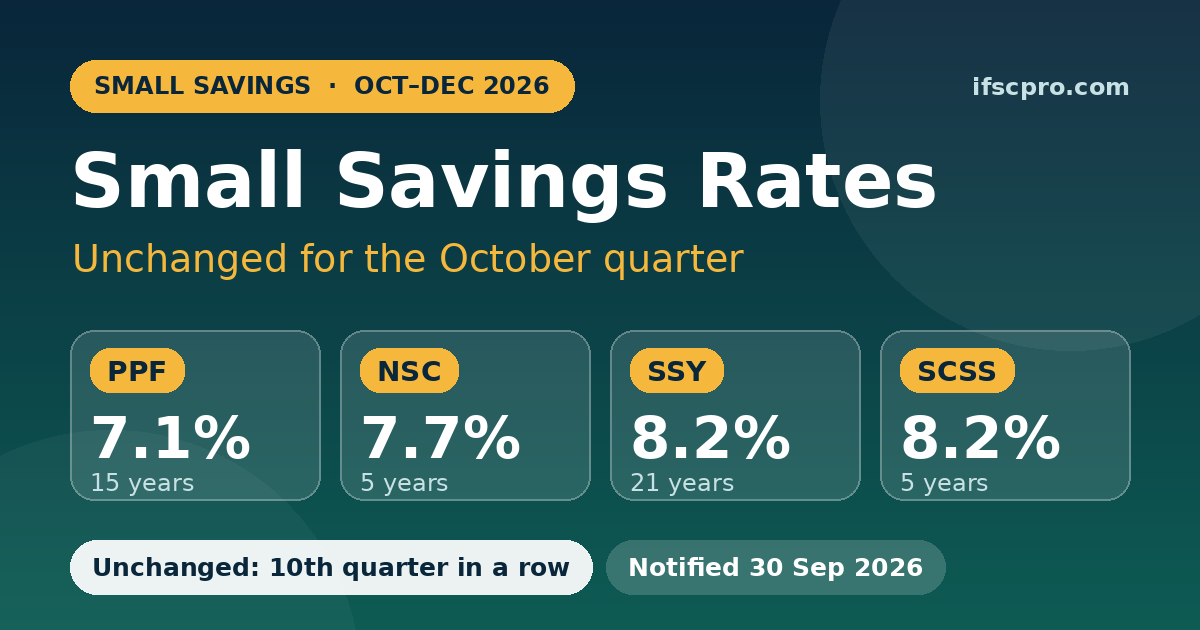
The government has kept interest rates on small savings schemes unchanged for the October-December 2026 quarter. The notification was issued by the Finance Ministry on 30 September 2026 and the rates are same as last quarter. The report says no change for the tenth straight quarter.
Do you have money in PPF, NSC, Sukanya Samriddhi or a post office deposit? Nothing new applies to you this quarter. If you’re thinking of starting one, here are the current rates side by side.I think it's a good thing that I'm not going to be able to get to the show.
Rates at a glance
| Scheme |
Interest rate (per annum) |
Tenure |
| Post Office Savings Account |
4.0% |
No fixed tenure Public Provident Fund (PPF) 7.1% 15 years Sukanya Samriddhi Account 8.2% 21 years Senior Citizens' Savings Scheme (SCSS) 8.2% 5 years National Savings Certificate (NSC) 7.7% 5 years Kisan Vikas Patra (KVP) 7.5% 115 months Post Office Monthly Income Scheme (MIS) 7.4% 5 years Time Deposit 1 year 6.9% 1 year Time Deposit 2 years 7.0% 2 years Time Deposit 3 years 7.1% 3 years Time Deposit 5 years 7.5% 5 years Recurring Deposit 5 years 6.7% 5 years
What each scheme is best for
- PPF: 15-year savings habit for the long term. The rate is moderate, but the long lock-in is great for people saving for retirement or a distant goal.**Sukanya Samriddhi: The highest rate on the list. Meant for the future education and marriage costs of a girl child. There are eligibility rules so make sure you check them out before opening an account.”
- SCSS: for senior citizens who need regular income. It has same top rate as Sukanya Samriddhi and pays interest every quarter.
- NSC: A lump-sum option available for five years, with interest accruing and paid at maturity.
- KVP: lump sum scheme which promises to double your money in the approximate period of maturity.
- Monthly Income Scheme: for people who want fixed amount credited every month.
- Time deposits and RD: for shorter-term goals or to save a fixed amount every month through the five-year RD.
A simple example
Let's say you put Rs.1,00,000 in an NSC at 7.7% a year. With annual compounding, it works out to approximately ₹1,44,900 after 5 years. 115 months, just under 10 years, to get to about Rs. 2,00,000 with a KVP of one lakh at 7.5%. These are ballpark figures for comparing schemes. The actual maturity amount depends on the official rules and the date of your investment.
What unchanged rates could mean for you
- New investors will be getting the same rates as last quarter, so no rush to invest before a change.
- PPF and Sukanya Samriddhi holders continue to receive the same rate this quarter. Their rates are after the quarterly announcement so can change in a future quarter.
- NSC and KVP investors continue to enjoy the rate applicable at the time of purchase of the certificate and are not subject to any change thereafter.
Before You Invest
- Compare the rate, lock-in period and tax treatment, not just the rate.You can check the official rate at the India Post website, your post office or your bank.
- Maintain accurate details of your savings account, including the IFSC code so that interest and maturity amounts are credited without delay.
- Match the scheme to your goal and your need for the money.
Most Asked Questions
Did the small savings interest rates change in October 2026?
No.
- For the October-December 2026 quarter, the Finance Ministry kept the rates unchanged.
What is the present PPF interest rate?7.1% for the quarter ending December 2026.
What is the highest interest rate small savings scheme?
Both Sukanya Samriddhi Account and Senior Citizens’ Savings Scheme offer 8.2% a year, the highest rates on the list.
What is the interest of NSC?
7.7% per annum. For a period of five years.
Maturity Period of Kisan Vikas Patra
- Now at 7.5% for 115 months.
How often small savings rates are revised?
Every three months. The rates for the next quarter are announced by the government near the end of the current quarter.
- This article is for general information purposes only and is not financial advice. The rates shown are those in force at the time of writing.
|